


Chief Warrant Officer Three William “Bill” H. Tuttle was born on 4 December 1950 in Nogales, Arizona, into a family of farmers and miners who settled in the border town of Yuma, Arizona. He enlisted in the U.S. Army in August 1968, at the age of 17. CW3 Tuttle received an invitation to join the Army Golden Knights, but instead within one year of enlisting, he was on the battlefront in Vietnam assigned to the 173rd Infantry Brigade, 82nd Airborne Division, as a signalman and search and rescue. He was injured in January 1970, which ended his time in Vietnam.
Upon recovery from his injuries, CW3 Tuttle returned to the 82nd Airborne Division at Fort Bragg, North Carolina, and was asked to instruct Weaponry at the United States Military Academy at West Point, New York. In 1972, he was selected for Warrant Officer Candidate School and attended flight School at Fort Wolters, Texas, and Fort Rucker, Alabama. He graduated from flight school in 1973 and returned to the 82nd at Fort Bragg as a UH-1 Huey pilot. Once in this position, he was granted permission to make one final jump so he could receive his Master Parachutist Badge.
In 1976, CW3 Tuttle and his family moved to Seoul, South Korea, where he flew out of Sangnam. One of the highlights of his tour in Korea was being asked to be the personal pilot for Senator John Glenn during his visit, during which time, Senator Glenn shared stories of his own experiences as a pilot in the Korean War as they flew over those areas.
In 1978, CW3 Tuttle completed the Aviation Advanced Course at Fort Rucker, Alabama, and was then assigned to the 193rd Infantry Brigade at Fort Clayton, Panama, where he flew out of Albrook Air Force Station. During his three years in Panama, he flew with the Organization of American States (OAS) conducting border patrol operations between Honduras and El Salvador, and Peru and Equador. He was also assigned as the instructor for the annual High Altitude Flight Training in Costa Rica.
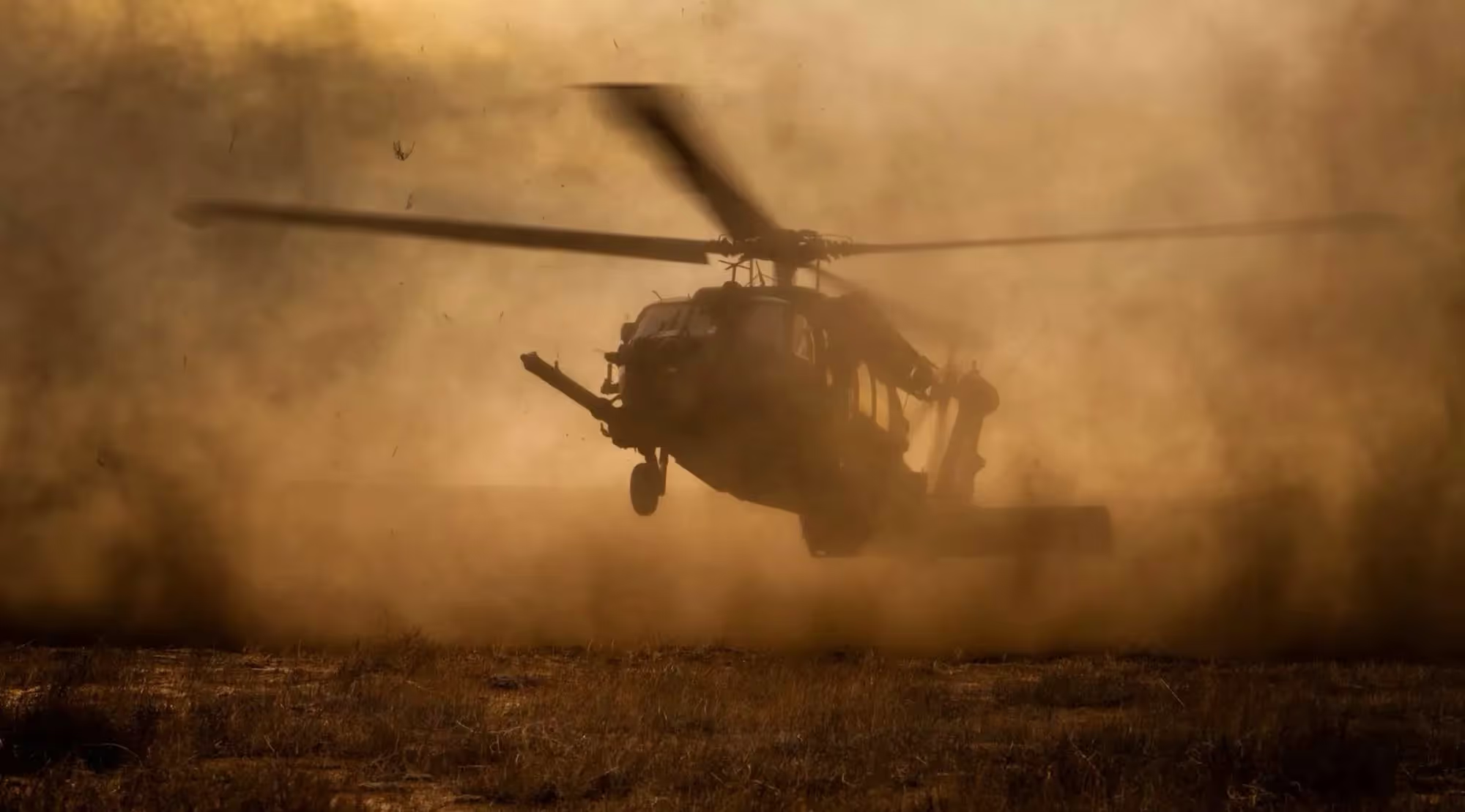
In 1981, CW3 Tuttle was assigned as a pilot to 2nd Battalion, 75th Ranger Regiment at Fort Lewis, Washington, during which time he learned about the 160th Aviation Battalion at Fort Campbell, Kentucky. He immediately applied, was interviewed, and accepted, which lead to his family’s relocation to Fort Campbell in December 1982. Upon his arrival to the 160th, CW3 Tuttle began flying the UH-60 Black Hawk.
CW3 Tuttle died on 4 October 1983, when the UH-60A Black Hawk helicopter, #999, he was piloting crashed in the Atlantic Ocean off the coast of Panama. The subsequent rescue mission failed to recover CW3 Tuttle’s remains.
CW3 Tuttle’s awards and decorations include the Silver Star, Bronze Star Medal w/”V” Device (1 OLC), and the Purple Heart (1 OLC). He was posthumously awarded the Meritorious Service Medal.
His time with the Night Stalkers of the 160th was his greatest accomplishment in his military career. CW3 Tuttle is survived by his wife, Diana; daughter, Josie; and son, Dominic. Diana is a retired Pastor in the International Church of the Nazarene and resides in Chino Valley, Arizona. Josie is married to U.S. Air Force (Retired) Technical Sergeant Troy Trimnal, and resides in Phoenix, Arizona. Dominic is a Helicopter Pilot/Instructor/Flight Examiner in Denver, Colorado. Between his two children, CW3 Tuttle has eight grandchildren: Brooke, Brendon, Dalton, Ryan, China, Alexa, William, and Joshua. The extensive search and rescue mission failed to recover CW3 Tuttle’s remains; he is memorialized in Phoenix, Arizona, at National Memorial Cemetery of Arizona, Section MA, Site 432.



.svg)